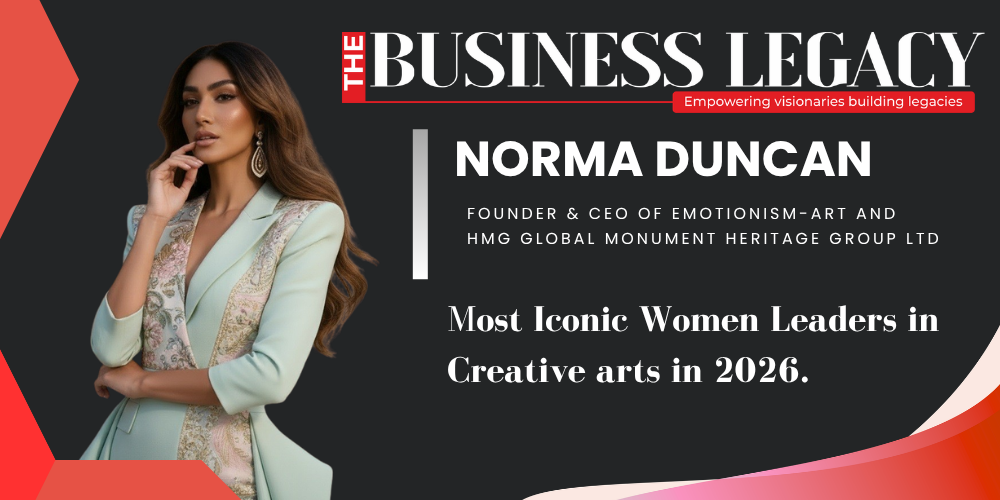
In the global creative economy where art, technology, sustainability, and entrepreneurship increasingly intersect-few figures embody this convergence as comprehensively as Norma Duncan. With more than thirty-eight years of experience in the creative industry, Duncan has evolved from a child discovering the magic of drawing to a visionary founder building a globally scalable art and innovation ecosystem.
Her journey spans artistic creation, intellectual property development, technological innovation, global partnerships, and industry leadership. As the founder of Emotionism-Art and the CEO of HMG Global Monument Heritage Group Ltd, Duncan has cultivated a rare hybrid identity: part artist, part inventor, and part strategic architect of emerging creative markets.
Her work has earned international recognition, including dozens of award nominations and numerous wins between 2022 and 2026. Yet behind the accolades lies a story that begins with something far simpler-one child, a pencil, and a moment of realization that imagination can be transformed into reality.
The First Spark: A Childhood Discovery
For Norma Duncan, the origin of her creative journey traces back to a formative childhood moment.
At just four years old, she experienced what she now describes as a profound awakening-the realization that the mind can generate ideas, and the hands can bring them into existence.
Raised in an environment where education and self-discipline were emphasized from the earliest years, Duncan was already accustomed to learning routines involving reading, writing, simple mathematics, and telling time. Her mother encouraged independent study, often leaving her to complete schoolwork on her own after returning home from school.
One afternoon, she sat down with her mathematics notebook, an A5 exercise book lined for practicing calculations. The task was routine: solving the equations assigned by her mother.
But that day something unexpected happened.
Earlier on her walk home through a nearby park, she noticed a cat perched in a tree. The image lingered in her mind. Instead of solving the math problem before her, she placed her pencil on the paper and began sketching the cat from memory.
It was her first drawing.
The experience was electrifying. In that moment she realized that imagination could be transformed into something tangible. The simple act of translating an image from her mind onto paper produced an emotional response she still remembers vividly-joy, clarity, and a powerful sense of discovery.
That realization became the foundation of a lifelong creative pursuit.
“I understood,” she reflects, “that I could imagine something and create it from nothing.”
The emotional intensity of that moment would eventually inspire the philosophy behind her artistic brand: Emotionism-Art.

The Evolution of Creative Purpose
Over the decades that followed, Duncan’s creative passion expanded beyond traditional art and design. What began as drawing evolved into multidisciplinary exploration across visual art, innovation, and technological problem-solving.
Her work gradually incorporated themes that reflect broader societal concerns-sustainability, environmental responsibility, and the development of systems that minimize waste while supporting future generations.
Rather than viewing art solely as aesthetic expression, Duncan began to approach creativity as a tool for solving real-world challenges.
This perspective helped shape the philosophy behind her work: that creativity should contribute positively to the planet and the communities that inhabit it.
Sustainability, carbon efficiency, and responsible production models now play a significant role in her approach to both artistic and business development. For Duncan, creative output must do more than inspire-it should also support a healthier and more sustainable future.
From Artist to Innovator
During her twenties, Duncan experienced another pivotal shift in perspective. She began to recognize that the principles of art and design could extend beyond visual expression and into the realm of technological innovation.
This realization marked the beginning of a new chapter.
She started documenting ideas concepts that blended artistic thinking with engineering logic. Over time, these ideas developed into practical innovations designed to improve existing products or systems.
Curiosity drove the process. Duncan wanted to understand whether the concepts she envisioned could function in the real world.
The question led her toward intellectual property.
At the age of twenty-seven, she submitted her first patent application, marking her entry into the innovation landscape. The product-though still confidential due to legal agreements-reimagined a widely used object that had remained largely unchanged for centuries, introducing a modern safety feature designed to improve usability.
Today Duncan holds multiple patent-pending publications through the UK Intellectual Property Office and several registered design protections through the European Union Intellectual Property Office. These protections extend across dozens of countries throughout Europe.
Industry recognition for her innovations has also followed. The EUIPO has invited her multiple times over the past eight years to submit an application for the prestigious Design Europa Awards-a recognition she intends to pursue once her innovation can be publicly disclosed.
These achievements reinforced an important realization: her creativity extended beyond artistic practice into scientific thinking and technological development.

Building the Foundations: Emotionism-Art
In 2012, Duncan formally launched Emotionism-Art as a sole-trader creative brand.
The concept was built around the emotional connection between artist and viewer-artworks created through personal expression but designed to resonate with audiences on a deeper emotional level.
What began as a creative platform gradually evolved into a luxury art brand operating within the global art market.
Scaling the brand, however, presented significant challenges.
One of the most critical obstacles was establishing a reliable international supply chain capable of meeting global demand. Duncan recognized early that digital access to international markets would eventually expose her work to billions of potential collectors.
But reaching that audience required partnerships with established art institutions and marketplaces capable of distributing artwork globally.
Securing those relationships took years.
Through persistence and reputation building, Duncan eventually partnered with internationally recognized art platforms that specialize in distributing both original artworks and collectible editions across global markets.
These partnerships expanded the reach of Emotionism-Art dramatically, allowing her work to be accessed by collectors in more than 160 countries.
Over time, the brand’s digital presence grew significantly as well, attracting tens of thousands of early online visitors and laying out the groundwork for scalable global expansion.
Recognition and Industry Impact
Between 2022 and 2026 Duncan’s work began receiving extensive recognition across international business and creative industry awards.
She has since been shortlisted for more than fifty prestigious honors and has secured numerous award wins recognizing her achievements in sustainable art trading, business innovation, and industry leadership.
For Duncan, these accolades hold personal significance beyond professional validation.
In many cases, the recognition represents a form of equality-acknowledgment that her work stands alongside that of leading male counterparts within traditionally male-dominated sectors.
It also confirms something deeply meaningful to any artist: that audiences value the work as much as the creator values making it.
The awards, she says, are humbling. They affirm that her ideas are not only being seen but are contributing to meaningful change within the creative industries.
Balancing Luxury with Accessibility
Operating in the luxury art sector presents a unique challenge: maintaining exclusivity while also expanding access to a global audience.
Duncan approaches this balance through a multi-tiered model that includes original artworks, limited editions, open edition prints, and even-art investment opportunities.
All works under the Emotionism-Art brand are created exclusively by Duncan, ensuring that the artistic identity remains distinct and controlled. At the same time, distribution partnerships allow collectors worldwide to access different tiers of artwork depending on their interests and investment capacity.
The next phase of this strategy involves the development of a digital secondary marketplace dedicated exclusively to Emotionism-Art works.
This platform will allow collectors to buy, sell, and trade artworks within a regulated environment designed to preserve authenticity and market integrity.
The system will also incorporate services such as restoration, resale support, and digital authentication records.
Duncan envisions a long-term generational trading ecosystem in which collectors can resell artworks directly within the Emotionism-Art network while maintaining transparent provenance.
In the future, regulatory oversight from financial authorities may also allow the company to introduce art investment products, expanding access even further.
Entering the Technology Sector
The expansion of her creative vision into technology ultimately led Duncan to establish HMG Global Monument Heritage Group Ltd in 2020.
The company functions as a smart-technology solutions enterprise designed to develop and test innovative ideas emerging from her research and creative thinking.
Operating as a startup, the organization focuses on niche technological solutions that address specific market needs across industries.
Although many of these projects remain confidential due to commercial partnerships and intellectual property protections, Duncan describes the company as a platform for translating imaginative concepts into practical solutions.
In essence, HMG Global Monument Heritage Group represents the technological extension of her creative philosophy.
Leadership in Male-Dominated Industries
Throughout her career Duncan has navigated sectors traditionally dominated by men, including technology, innovation, and corporate governance.
Her approach to leadership has remained straightforward.
Rather than framing her identity primarily through gender, she positions herself as a business leader and visionary whose ideas speak for themselves.
By focusing on strategy, sustainability, and long-term planning, she has cultivated a reputation as a serious entrepreneur capable of operating at the highest levels of industry.
The emphasis, she says, has always been on delivering results and building systems that function effectively regardless of gender expectations.
Creativity in the Age of Artificial Intelligence
The emergence of artificial intelligence has introduced new tools into the creative process, and Duncan has begun incorporating these technologies into selected projects.
However, she approaches AI as a collaborative enhancement rather than a replacement for human creativity.
In recent collections, she has experimented with AI-assisted development while maintaining a primarily human-driven creative process.
Typically, AI contributes around forty percent of the development process-helping to accelerate production timelines and allowing her to experiment with new visual approaches.
Despite these technological integrations, Duncan maintains that originality remains the core of artistic integrity.
The initial ideas always originate from her own imagination.
AI simply helps explore new possibilities within those concepts.
Building a Global Network
The scale of Duncan’s international partnerships did not happen overnight.
Since the age of seventeen, she has steadily built relationships across industries-forming connections with professionals, organizations, and companies that share similar values and ambitions.
Over time these relationships evolved into collaborations, investment partnerships, and distribution networks.
The process required patience and consistent engagement.
According to Duncan, successful partnerships depend on transparency, shared goals, and long-term commitment.
Organizations are more willing to collaborate when they see that a visionary idea is supported by sustained dedication and practical strategy.
Today many of her partnerships span decades and involve institutions that have operated for centuries.
These relationships form the backbone of her global ecosystem.
Technology and the Future of Creative Industries
Looking ahead, Duncan believes technology will fundamentally reshape creative industries in several keyways.
Artificial intelligence will become increasingly integrated into artistic practice, offering new tools for design, architecture, and digital production.
Verification systems powered by AI will help authenticate artworks, protect intellectual property, and preserve market integrity.
Digital ecosystems will transform how artworks are traded and financed, enabling new financial models and cross-sector collaboration.
Immersive technologies will also open the door to new creative experiences, merging visual art with gaming, virtual environments, and interactive storytelling.
For Duncan, these developments represent the next chapter in the evolution of creativity.
Leadership, Responsibility, and Industry Standards
Beyond her entrepreneurial ventures, Duncan has also contributed to discussions surrounding industry legislation and standards within the United Kingdom.
As a subject-matter expert, she has participated in consultations aimed at improving professional frameworks within the creative sector.
She believes influential leaders have a responsibility to share insights that help refine outdated systems and strengthen industry integrity.
However, she emphasizes that such improvements are always collective efforts.
Regulators and independent panels ultimately decide which recommendations to become official policy.
Industry leaders simply contribute experience and perspective to the process.
A Defining Moment
After nearly four decades in the creative industry, Duncan believes the past year has been one of the most defining periods of her career.
Her growing list of award nominations and wins, invitations for academic honors, and extensive media coverage have signaled a new level of global recognition.
Perhaps most significantly, her story is reaching increasingly large audiences.
Major media features scheduled in the coming years are expected to introduce her work to hundreds of millions of readers worldwide.
For Duncan, this moment represents both an achievement and a beginning.
It marks the point where decades of creative development, business strategy, and innovation are finally converging into a globally recognized legacy.
The Legacy Ahead
As one of the most recognized women leaders in the creative and arts sector today, Duncan hopes her legacy will extend beyond personal success.
Her goal is to create an ecosystem in which future generations of women entrepreneurs and creatives are encouraged to pursue ambitious visions and receive the support necessary to realize them.
A sustainable creative economy-one that values innovation, diversity, and environmental responsibility-is the future she hopes to help shape.
And like the child who once drew a cat in a notebook instead of solving a math problem, she continues to believe in the power of imagination.
Because sometimes the most extraordinary journeys begin with a single unexpected sketch.
Also Read: Norma Duncan as Most Iconic Women Leaders in Creative arts in 2026