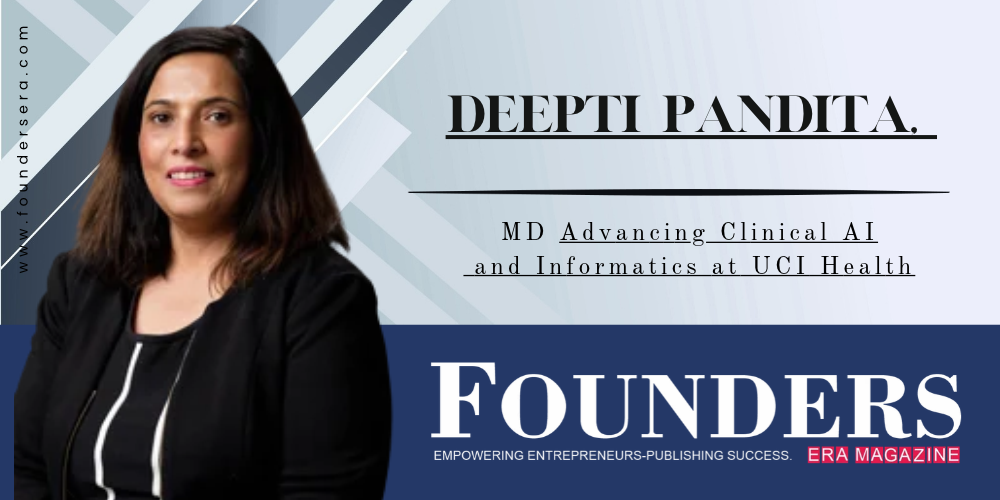
Deepti Pandita, MD: Advancing Clinical AI and Informatics at UCI Health
Healthcare technology is becoming less about just implementing digital tools in hospitals, but rather about how they are then put to use in the real-world clinical setting. Electronic health records, clinical analytics, artificial intelligence and digital workflows all have to be implemented in a setting where decisions can have life-long repercussions.
It is in this context that clinical informatics leadership is proving to be extremely vital. Deepti Pandita, MD, serves as Chief Medical Information Officer (CMIO) and Vice President of Clinical Informatics at UCI Health. UCI Health has characterized her work as spanning AI governance, digital transformation and clinician efficiency. More recent UCI Health materials also identify her as Chief Medical Informatics and AI Officer.
Her role represents the confluence of medicine, information technology and organizational strategy. It also reflects a changing healthcare landscape where physicians are increasingly being tasked with choosing how data, software and artificial intelligence are introduced into the clinical setting.
Who Is Deepti Pandita, MD?
Deepti Pandita, MD, is a physician and a clinical informatics leader at UCI Health and the UC Irvine School of Medicine. UCI’s faculty page names Dr. Pandita as a physician in the Division of Hospital Medicine and Palliative Medicine, while the American Medical Informatics Association introduces her as a physician, board-certified in internal medicine and clinical informatics.
Her expertise stems from a background that reflects the value of physicians’ perspectives in healthcare technology. The viewpoint of a clinician is fundamentally different from that of a business or technology professional. Clinicians experience the burden of documentation, the need for clinical decision support, and the challenges of information management and workflow optimization on a daily basis.
Clinical informatics creates a bridge between the perspectives, enabling technology solutions that truly understand the needs of clinicians and ultimately improving the quality of care and operational performance.
In her work at UCI Health, Dr. Pandita has been supporting the organization’s AI governance and digital transformation initiatives and has contributed to the development of strategies to drive clinician efficiency and ensure ethical AI usage. UCI Health has recognized her role by featuring her in the executive insights section on the company’s website.
Deepti Pandita, MD: Role Overview
| Category | Details |
|---|---|
| Name | Deepti Pandita, MD |
| Position | CMIO & VP Clinical Informatics |
| Organization | UCI Health |
| Focus Area | Clinical AI / Informatics |
| Industry | Healthcare Technology |
The role is significant because healthcare organizations need leaders who can understand both the clinical problem and the technology being considered as a possible solution.
Understanding the Role of a CMIO
A Chief Medical Information Officer works in the intersection of clinical, technical and administrative groups. The scope of responsibility varies depending on the organization, but the role generally focuses on aligning information systems with clinical practice.
A CMIO collaborates with physicians and nurses, information technology teams, executives, data specialists and other stakeholders. The aim is not only to introduce new technologies, but also to make them safe and effective in a clinical environment. An electronic health record may contain a wealth of information about a patient, but this information has to be organized, available at the right time and in a format understandable to medical professionals in order for it to be useful.
That is why the role of CMIO in healthcare is becoming so important as health systems adopt more and more advanced digital technologies. Pandita’s work is an example of physician leadership in healthcare technology. UCI Health has pointed to her views on artificial intelligence governance and the need for organizational oversight before implementing AI software.
Clinical AI and the Future of Healthcare
Artificial intelligence is being explored today in a variety of healthcare settings and applications, ranging from automating administrative functions to assisting in clinical practice and decision-making, documentation, predictive analytics and medical imaging. The important question, however, should not only be whether AI can perform a task, but whether it actually solves a meaningful problem without incurring other risks or unnecessary complexities.
This is especially true for clinical AI in healthcare. UCI Health has featured discussions on Pandita’s applications and implementations of AI. For example, a UCI Health Clinical Connection podcast includes topics such as predictive analytics, ambient documentation, imaging-related applications and AI governance.
Potential areas include:
- Clinical decision support
- AI-assisted documentation
- Patient communication workflows
- Predictive analytics
- Medical imaging support
- Administrative workflow automation
- Data-driven population health management
These applications are not interchangeable. Each has different requirements for validation, monitoring, workflow integration and human oversight.
Major Areas of Clinical Informatics
| Area | Potential Healthcare Role |
|---|---|
| Clinical Decision Support | Helps clinicians access relevant information |
| Electronic Health Records | Supports digital clinical workflows |
| Data & Analytics | Enables healthcare insights |
| AI Applications | Supports selected clinical and operational use cases |
| Interoperability | Helps connect healthcare information across systems |
Clinical informatics therefore extends beyond artificial intelligence. It includes the broader systems that allow clinical information to be collected, exchanged, interpreted and used.
Clinical Informatics at UCI Health
UCI Health works in an academic health system that brings together clinical care, education and research. This makes it a truly vital environment for clinical informatics, in which digital systems can have an impact on all three areas.
The UCI Health clinical informatics function fits into this broader ecosystem of electronic health records, data, analytics, interoperability and digital transformation. Pandita’s role involves tying together these technological underpinnings with actual clinical needs: UCI Health has characterized her work as driving AI governance, digital transformation and clinician-efficiency initiatives.
One key lesson from this approach is that technology should begin with a clearly defined clinical or operational problem. In a 2025 UCI Health discussion, Pandita stressed that AI should not be adopted just for the sake of innovation; rather, organizations should ask themselves if a particular issue can be addressed through such a solution, and establish appropriate governance around its use. That principle can be applied far beyond UCI Health. Hospitals can acquire sophisticated tools, but their success will depend on how well they serve patients’ and clinicians’ needs.
Why Physicians Matter in AI Adoption
AI systems may be technically impressive, but clinical environments have requirements that cannot be understood from software specifications alone.
Physicians can help identify questions such as:
- Does the tool address a real clinical problem?
- Does it fit naturally into existing workflows?
- What information is the system using?
- How reliable are its outputs?
- What happens when the system is wrong?
- Can clinicians understand or challenge its recommendations?
- Does the tool create additional documentation work?
Pandita has publicly encouraged physicians to critically evaluate AI products, including their clinical relevance, evidence, transparency, privacy, cybersecurity and regulatory considerations.
This reflects a broader shift toward physician-led healthcare AI, where clinical professionals participate in technology governance rather than simply becoming end users of systems selected elsewhere.

Challenges in Implementing Clinical AI
AI adoption can create opportunities, but healthcare organizations also face substantial implementation challenges.
Data Quality
AI systems depend on data. If information is incomplete, inconsistent or poorly structured, the output may be less useful. Healthcare organizations therefore need strong data-management practices alongside AI initiatives.
Workflow Integration
A technically capable tool can still fail if it interrupts clinical workflows. An AI application that requires clinicians to leave their normal systems or perform additional steps may not deliver the expected value.
Clinician Trust
Healthcare professionals need confidence that technology is reliable and appropriately monitored. Trust is difficult to establish when users cannot understand how a system works or when performance changes over time.
Patient Safety
AI used around clinical decision-making requires appropriate oversight. Human review remains important, particularly when errors could affect diagnosis, treatment or patient outcomes.
Privacy and Security
Healthcare data is highly sensitive. AI implementation therefore has to account for privacy, cybersecurity, access controls and applicable regulatory requirements.
Bias and Fairness
AI models can reflect limitations in the data used to develop them. Healthcare organizations need processes for identifying and monitoring potential disparities in performance.
Measuring Real World Value
An AI tool should ultimately be assessed by whether it solves the problem it was intended to address. Faster processing alone does not necessarily mean better care.
Clinical AI Implementation Considerations
| Consideration | Why It Matters |
|---|---|
| Data Quality | AI depends on reliable information |
| Workflow Integration | Technology must fit clinical routines |
| Patient Safety | AI tools require appropriate oversight |
| Clinician Trust | Adoption depends on confidence and usability |
| Privacy | Healthcare data requires strong protection |
These considerations help explain why AI governance has become a central component of modern clinical informatics.
Deepti Pandita, MD and the Changing Healthcare Technology Landscape
The healthcare technology world has evolved considerably. Early digital transformation initiatives often focused on electronic records, digitized processes and information exchange. Now, health systems are also considering generative AI, predictive models, ambient documentation, and increasingly sophisticated decision-support systems. This creates a different type of leadership challenge. A CMIO must look not only at the potential for a technology to be effective, but also on appropriate placement in the care process. UCI Health’s published material on AI governance emphasizes including executive leadership and relevant stakeholders in the early phases before any AI solution is deployed. Pandita’s public commentary has similarly stressed governance, clinical relevance and responsible implementation.
Her work also shows the increasing link between Deepti Pandita healthcare technology leadership and broader clinical transformation. In 2026, UCI Health announced that she had received a HIMSS-AMDIS Physician Executive Leader Award recognizing her work in healthcare information and technology. The recognition is one piece of evidence of the growing visibility of physician informatics leadership as healthcare organizations work through AI adoption.
Future Opportunities for Clinical Informatics
The future of clinical informatics is unlikely to be defined by one technology. Instead, healthcare systems will continue to combine electronic records, analytics, interoperability, automation and AI.
Several areas offer potential opportunities.
| Opportunity | Potential Impact |
|---|---|
| AI-Assisted Workflows | Reduce unnecessary administrative burden |
| Predictive Analytics | Support earlier identification of risks |
| Clinical Decision Support | Provide relevant information at the point of care |
| Personalized Care | Support more individualized healthcare approaches |
| Digital Transformation | Improve coordination between people, data, and technology |
The future of clinical informatics will likely depend as much on implementation discipline as technical capability.
Healthcare organizations will need to determine which problems genuinely require AI, which can be addressed with simpler tools, and where human judgment should remain central.
That is particularly relevant to artificial intelligence in clinical informatics. The objective should not be to replace professional expertise with algorithms. Instead, technology can be designed to help clinicians work with information more effectively.
The Broader Importance of Physician-Led Informatics
The career and responsibilities of Deepti Pandita, MD, represent a growing trend in healthcare technology: clinical expertise and digital expertise are becoming more interconnected. The rise of the Deepti Pandita clinical informatics leadership at UCI Health reflects how the CMIO position is evolving as healthcare organizations move from simple digitization towards utilizing AI-powered healthcare. Her work also takes place in a broader professional environment that involves clinical informatics education, data governance, AI evaluation, workflow design and digital transformation.
The most successful healthcare technology programs are rarely based solely on technology. They rely on cross-disciplinary collaboration between clinicians, informaticians, data scientists, engineers, administrators and patients. That collaborative approach will be vital as health systems evaluate more advanced AI systems.
Read More: Chris Waugh: 7 Powerful Ways He Advances Healthcare Design at Sutter Health
Conclusion
Dr. Pandita is part of the increasing number of physician leaders in the healthcare technology field. As Chief Medical Information Officer and Vice President of Clinical Informatics for UCI Health, her work covers such areas as clinical informatics, AI governance, digital transformation and clinician efficiency. UCI Health and other professional organizations have published her work and she has contributed to the advancement of responsible healthcare technology and informatics.
The larger lesson is more than just any specific technology. Clinical AI can be valuable when it addresses a true healthcare need, fits into the clinical workflow and is implemented with appropriate oversight. But digital transformation requires more than just the right algorithms. It needs reliable information, proper governance, clinician engagement, patient-centered design and ongoing evaluation.
As healthcare organizations continue to experiment with AI and advanced digital systems, physician-led informatics will play a critical role in connecting the possibilities with the practical realities of medicine. Technology can offer new solutions. Clinical expertise decides how those solutions should be used.
Read More: Business legacy